

Listen to the blog post here:
A monument announces to the public who a nation has chosen to honour. This choice is usually made by a privileged few on behalf of the many; kings and generals are cast in bronze and raised high above the crowd whilst ordinary people stay at street level, looking up.
One & Other, a mass-participation artwork devised by Sir Antony Gormley, commissioned by the Mayor of London and produced by Artichoke, turned this traditional hierarchy on its head, inviting ordinary people to step off the pavement and onto a pedestal for their 60 minutes of fame.
For 100 uninterrupted days and nights in the summer of 2009, 2,400 members of the public occupied the Fourth Plinth for one hour each. Streamed live on Sky Arts, 24 hours a day, and watched by millions, together, they created a living portrait of 21st-century Britain in the symbolic heart of London. It was the longest ever live outside broadcast yet attempted.

Trafalgar Square, 1908 by Notman Photo Co – This image is available from the United States Library of Congress’s Prints and Photographs division under the digital ID pan.6a22725
Trafalgar Square has long been treated as the nexus of London. A point in the square is treated as the official centre of London, both in legislation and when distances to the capital are measured.
When the square was built in the 1840s, the three corner plinths were filled with statues of King George IV and military commanders Charles Napier and Henry Havelock. An intended fourth statue of William IV failed to be funded by public subscription, leaving the final plinth empty for around 150 years.
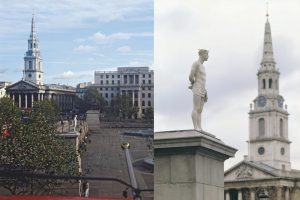
Left: Ecce Homo by Mark Wallinger, 2009. Photo by John Riddy. Right: Ecce Homo by Mark Wallinger. Image courtesy of the artist.
This changed in 1998 following a campaign by the Royal Society for the Arts, who suggested the plinth could be used as a platform for contemporary sculpture, thus breaking the deadlock in the argument of which dignitary was the best choice to fill the plinth. When Mark Wallinger’s Ecce Homo was placed upon the empty fourth plinth, its life-size, bound figure of Christ introduced vulnerability and doubt into a setting dominated by bronze heroes, a fitting artwork for a new millennium. Ecce Homo was followed by Bill Woodrow’s Regardless of History in 2000 and Rachel Whiteread’s Monument in 2001. All three artworks shifted attention away from the heroic figure and towards ideas surrounding monuments and the plinth itself, demonstrating that it could host thought-provoking contemporary art.
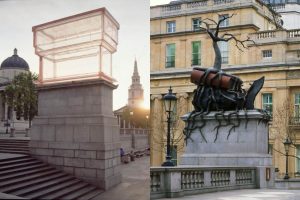
Left: © Rachel Whiteread. Right: © Bill Woodrow. Photos by Michael Crimmin / Greater London Authority.
In 2003, the Greater London Authority assumed responsibility for the plinth, setting up the commissioning programme that continues today. A decade later, Gormley and Artichoke shifted the emphasis again when, instead of installing another singular artwork, they gave the space to thousands of ordinary people.
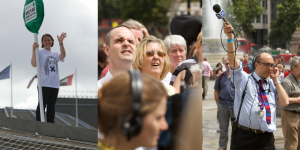
Left: Rachel Wardell Plinther 0001 as part of One & Other, 2009. Photos by Matthew Andrews
When One & Other launched at 9:00 on 6 July 2009, it instantly captured the nation’s imagination. First on the plinth was Rachel Wardell, a 35-year-old mother from Lincolnshire who used her hour to highlight the work of the NSPCC. Over the days and weeks that followed, the Fourth Plinth became an unpredictable open-air stage, with a 24-hour live audience, both in Trafalgar Square and online.
A new term was coined for participants – ‘Plinther’ – and Artichoke even managed to introduce the idea into a storyline in BBC Radio 4’s The Archers, the world’s longest-running radio soap opera. Each Plinther used their hour in radically different ways. Some conducted science experiments or taught the crowds below them a new skill, others campaigned for causes, made art, performed, or simply presented themselves to the public. The plinth became variously:
Responses could be sharply contrasting and provoked nationwide discussion. Sky Arts broadcast a live 24-hour webcam, both on television and online, that became the longest-running livestream of its time.
Whilst One & Other generated several notable nude performances, from Gunter running naked across the square to avoid security, to Lady Godiva riding a rocking horse in nothing but boots, two contrasting nude performances highlighted the diverse interpretations of vulnerability and freedom.
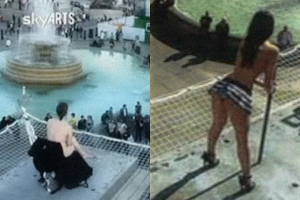
Plinther No 1115 & 1852 as part of One & Other, 2009. Screenshots from Sky Arts Livestream via oneandother.co.uk (archived)
Plinther 1115, Susanna Meese-Simpson, posed naked as if for a life study, borrowing the formal convention of the artist’s model and later appearing amongst the Guardian’s top ten Plinthers. Plinther 1852, Naomi McDonald, also took to the plinth nude but garnered much criticism from the masses. Her topless pole-dancing generated enough attention to crash the livestream website.
The coverage surrounding the dancer was more ambivalent than outraged. The Londonist, having previously dismissed another naked, middle-aged Plinther as unappealing, proceeded to welcome Naomi’s dance as a more enjoyable spot of public nudity, whilst grumbling that the project sometimes drew out the nation’s baser tastes.
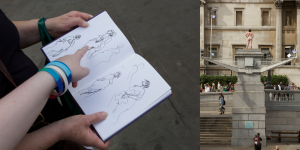
Rachel Elliot, Plinther 1183 as part of One & Other, 2009. Photo by Matthew Andrews
Where Susanna’s nudity borrowed from the authority within art history and was itself received as art, Naomi’s nudity borrowed from the language of entertainment and was received as spectacle. Their receptions showed how quickly a single public gesture could expose different assumptions about art and social norms.
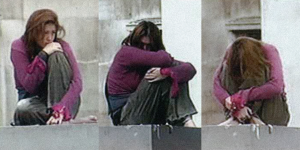
Claire Ross, Plinther 1516 as part of One & Other. Screenshots from Sky Arts Livestream via oneandother.co.uk (archived)
When Gormley was later pressed to name a favourite among all 2,400 plinthers, he reluctantly chose an agoraphobic woman from Brighton, Claire Ross: not the boldest or the most watched, but someone who did nothing except be seen in her most uncomfortable state.
"I didn’t really want to be picked for this. I only put my name forward because a friend said I should… I intend to go up there and be as scared as I feel… make no attempts to overcome it or disguise it."
Claire offered the audience none of the provocation that comes with nudity. On the elevated slab of stone, she lay down and curled into a ball. She had not come to protest, perform or posture. She had come to show, without disguise, how frightened she felt in front of whoever happened to be watching; spectators stood in the square, passersby glancing up without context and many more who followed the live stream from screens around the world.
In a square of generals and kings, Claire didn’t claim authority or offer an easy message. Her presence was temporary and personal, yet it occupied one of the country’s most visible public stages. When interviewed, Claire noted on how close friends commended her courage for putting herself on a worldwide stage.
Gormley framed the project through three connected questions: who can be represented in art, how can we make it, and how can we experience it?
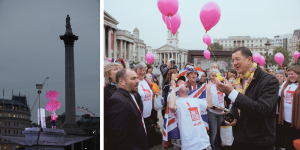
Antony Gormley & Plinther 2399 as part of One & Other, 2009. Photo by Matthew Andrews
One & Other replaced the single heroic figure with a succession of ordinary people, including participants speaking for communities and causes that are rarely monumentalised.
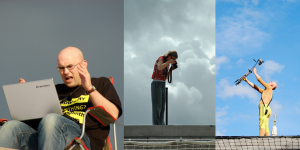
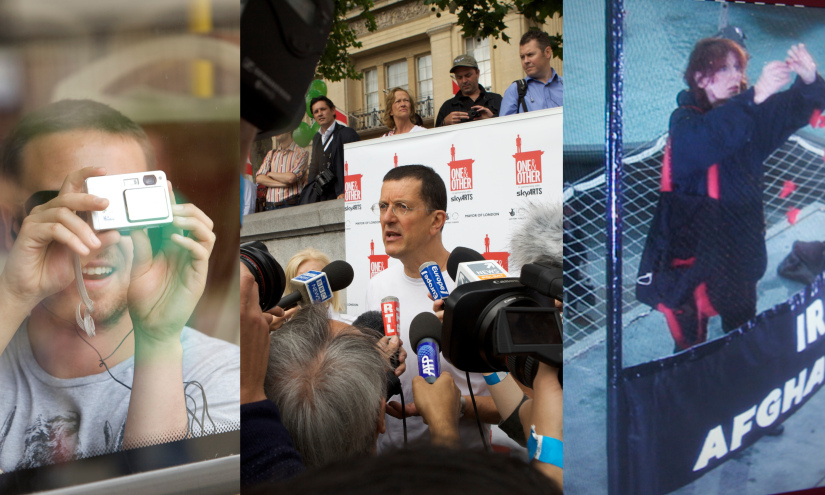
Plinthers as part of One & Other, 2009. Photos from Flickr. Left: Photo by user amonotak. Middle: Photo by user Eddie Clarke. Right: Photo by user Pagoo!
Artichoke provided the framework; 100 days, one person each hour, an open call, an algorithm and the infrastructure to make it all happen safely. Over 34,000 individuals from across the UK applied to be a part of the artwork. They were entered into a randomised lottery based on a computer algorithm that selected a range of ages, diversities and occupations that were representative of each region and nation. But it was the participants who determined the content. The artwork depended solely on the Plinthers decisions and what they could physically bring onto the stage without assistance.
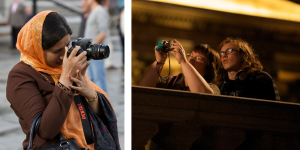
Audience interactions. Photos by Matthew Andrews
Viewers encountered the work both in Trafalgar Square and through a continuous online livestream produced by Sky Arts. With 8.8 million views and 33,000 comments on the website, the project sparked widespread discussion and debate. In the early social-media era, comments and online forums became part of the project’s public life.
Charlie Brooker, creator of the speculative TV series Black Mirror, compared the artwork to Big Brother, specifically calling it the Tate Modern edition of the reality show. This comparison, although presented in jest, highlights the tension between surveillance and observation. As audiences engaged with the work, they were prompted to consider the implications of being both a participant and an observer in an increasingly digitally connected world.
One & Other refused to offer a single, polished image of Britain. Instead, it produced a crowded portrait made from vulnerability, humour, criticism and unconventionality. Its significance lay in what happened on the plinth but also inherently in how people responded to it. That was the project’s central proposition: a monument could become less about who is elevated permanently and more about who is given the chance to be seen.
The Fourth Plinth has kept asking Gormley’s questions ever since. Elmgreen & Dragset’s Powerless Structures, Fig. 101 (2012) put a boy on a golden rocking horse where a military hero might have stood, questioning monuments built on military victory. Heather Phillipson’s THE END (2020) consisted of a drone stuck in whipped cream transmitting a live feed of the square, making watching and being watched part of the work. Teresa Margolles’s Mil Veces un Instante (2024) was made from the face casts of hundreds of trans, non-binary and gender non-conforming people.
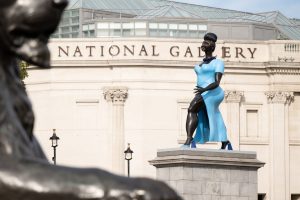
Lady in Blue, Tschabalala Self. Photo by Jeff-Spicer & PA Media Assignments
In September 2026, Lady in Blue by New York artist Tschabalala Self was unveiled on the Fourth Plinth. The 16th artwork of the commission programme saw a bronze-clad woman stride vibrantly through Trafalgar Square, inspired by the desire to bring a contemporary ‘everywoman’ to the square.
The Fourth Plinth has continued to be a curious window into the British cultural climate. In 2009, it showed Britain as it was: funny, frightened, brash, tender and unresolved. Every commission since has continued to depict the human experience in ways that keep ordinary people at the centre of the conversation, long after the last participant climbed down from the plinth.
NB: The voice/audio in this blog post has been generated using Artificial Intelligence