

Listen to the blog post here
‘Four cities. One movement. Every woman.’ This tagline was adopted for PROCESSIONS – a once-in-a-lifetime mass participation artwork that rallied women from our four UK capitals. Based on an idea by Creative Director Darrell Vydelingum, and commissioned by 14-18 NOW, PROCESSIONS marked the 100-year anniversary of the first British women voting. Artichoke commissioned 100 women artists across the UK and Ireland to work with arts and community organisations to make 100 beautiful banners as a way of reconnecting with this history, using colour and powerful messages to recreate the spirit of past movements.
On Sunday 10 June 2018, tens of thousands of women and girls came together with their banners in Belfast, Cardiff, Edinburgh and London; wearing scarves of green, white and violet, the colours of the suffragette movement. The women of this century were given a moment to celebrate, reflect and show what being a woman means today, with the rights we now enjoy, and the progress made since the early days of the vote.
“PROCESSIONS was commissioned to commemorate the centenary of the First World War, with focus on the vital role women played during this period. As men went to the front, women stepped into roles from which they had long been excluded.
At the same time, women were fighting for political representation. They were not simply granted the vote – they demanded it through sustained protest and activism. PROCESSIONS drew inspiration from the Suffragettes, who were highly skilled in using the banner as a visual identity to amplify their message. Banners became powerful tools in their campaign: bold, symbolic, and expertly crafted to capture public attention. What began as simple paintings on calico evolved into intricate artworks made from rich materials such as silk and velvet.
The right to vote gave women a platform – and this project sought to celebrate and continue that legacy by making those voices visible and heard.”
~ Darrell Vydelingum, PROCESSIONS Creative Director and Artist Curator
The iconic Suffragette colours were conceptualised in 1908 by Emmeline Pethick-Lawrence, the co-editor of Votes for Women magazine. Violet to represent loyalty and dignity, white for purity and green for hope. The colour scheme’s bright and striking contrast quickly became emblematic of the Suffragette movement and unified their individual voices. By turning their domestic skills into instruments of activism, these women made the cause instantly recognisable through banners, sashes and other protest materials.
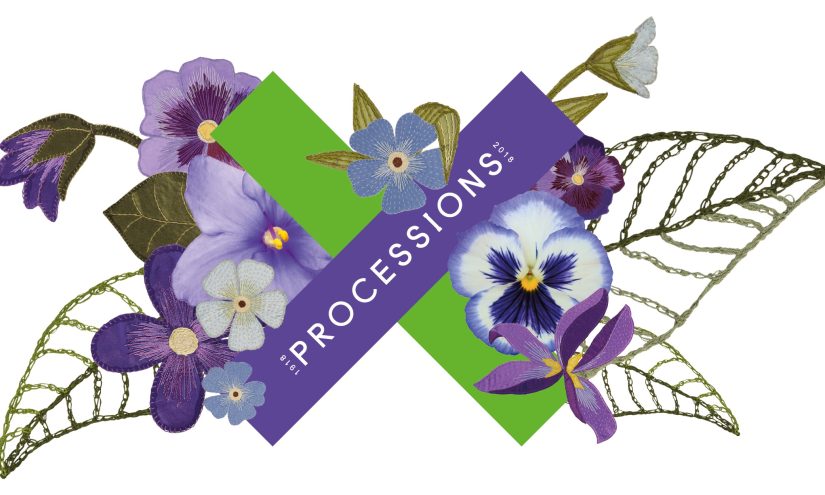
Clare Hunter, an expert on text and textiles was the banner-making consultant for PROCESSIONS and created a downloadable banner-making toolkit for the project. She noted that the Suffragettes purposely embellished their banners with delicate embroidery, including floral imagery, and so she hand-embroidered the flowers that became part of the PROCESSIONS identity. Flowers such as violets and pansies carried deeper meanings – symbolising loyalty, remembrance and the enduring spirit of the suffrage movement.
“It was the artist and designer Mary Lowndes who masterminded the banner pageantry. […] She distributed a banner-making guide […] to ensure that what she termed ‘women’s own adventure’ was manifested in glorious visual splendour, insisting that ‘a banner is a thing to float in the wind, to flicker in the breeze, to flirt its colours for your pleasure’.
Women gathered in local halls and their own homes to make banners which proclaimed who they were and where they belonged: the villages, towns and cities they came from; banners that celebrated the women through time who had championed female advancement. […]
Participants made their banners in fabrics displaced from the drawing room – silks, velvets, brocades – and purposely embellished with delicate embroidery to emphasise a woman’s presence. This was, Lowndes encouraged, to be ‘a declaration’, a visible assertion of women’s protest, of women sprung from the confines of domesticity to defiantly parade on the streets and claim their rightful place in public life. Over a quarter of a million people came out to watch them pass.”
~ Excerpt from ‘TEXT AND TEXTILES’
Hunter’s banner-making guide was distributed to organisations by Artichoke and downloaded by individuals from the project website. It contained comprehensive step-by-step instructions for banner assembly as well as signposted places to look for inspiration. Women, girls, and non-binary participants with wildly different lived experiences expressed both historical and contemporary concerns through the medium of textiles. A labour of love, the banner-making process remains relatively unchanged since the 1900s: large banners take approximately 6-8 hours of work to make; a decorated pole will take around 30 minutes to finish; a flag takes roughly 20 minutes; and a small pennant takes roughly 15 minutes of crafting.
“For PROCESSIONS, Artichoke’s 2018 event in honour of those marching women, it was my privilege to be commissioned to follow in Mary Lowndes’ footsteps and devise a banner-making kit for participants. Thousands of women and girls followed in the footsteps of their grandmothers and great-grandmothers to fashion banners from scraps of fabric and multi-coloured threads as visual expressions of twenty-first-century women.
These were banners that had no need to be delicate. They were flamboyant and multi-textural, reflecting the diversity and creativity of their makers. Their slogans told of confidence and energy: ‘Our Voice is Powerful and Will Be Heard’, ‘We Will Have What We Want’, ‘We Are Here’, ‘We Know Where We’re Going’, ‘Girls Bite Back’. […]
The hundreds of banners made for PROCESSIONS were heart-warming celebrations of challenges overcome and heartfelt manifestos for those that lay ahead: autographed in an exuberance of multi-layered colour, pattern and texture to materialise collective action. As the thousands of participants conjoined in their violet, white and green scarves and streamed through Britain’s city streets, their banners punctuated their flow as spirited exclamations of promise and power.”
~ Excerpt from ‘TEXT AND TEXTILES’
The Suffragette movement shows how a cause can be legitimised in the eyes of the public through something as simple as a colour scheme – to present a united front is to display your strength and resolve. The Suffragettes were one of the first groups to understand the power of identifying colours and use it to unify their call to action. Following PROCESSIONS, a selection of the banners were displayed at the Spill Festival, and all 100 hand-crafted banners were exhibited at London Scottish House as part of the Women Making History exhibition in 2022. For six weeks the banners were displayed in all their glory so that visitors could explore every stitch and motif up close. Banners contributed from groups like the LGBT Foundation, Southall Black Sisters and Girlguiding UK filled the space, hanging as vibrant symbols of our collective fight for equality and participating groups came from far and wide to see their work proudly displayed. You can check out the online PROCESSIONS banner exhibition here.
Colour, textiles and design have always been central to expressing women’s voices. From their origins on the streets with the first suffragettes to their prominent display in modern gallery exhibitions, banners like these have married the act of protest with art. Using slogans, imagery and colour in this way transforms a cause into something tangible, vivid and impossible to ignore.
Learn more about PROCESSIONS here.
PROCESSIONS 2018 was commissioned by 14-18 NOW, the UK’s arts programme for the First World War centenary, with support from Arts Council England, the National Lottery Heritage Fund, and from the Department for Digital, Culture, Media and Sport.
NB: The voice/audio in this blog post has been generated using Artificial Intelligence