

Listen to the blog post here:
This year, Artichoke turns 20. For two decades, we’ve worked with artists to transform public spaces – creating large-scale experiences that stay with people long after they’ve gone.
From London to Liverpool, Durham to Derry~Londonderry, we’ve reimagined streets, squares, coastlines and countryside, turning everyday places into sites of wonder.
To mark the occasion, we’re taking a moment to look back. Over the coming months, we’ll revisit some of the projects that have shaped Artichoke – unearthing untold stories, hearing from the artists and collaborators behind the work, and exploring what it takes to bring these ambitious ideas to life.
And to truly understand Artichoke, you have to go back way before 2006 when we took to the streets for the first time. There was a long road that led to that moment…
French street theatre company Royal de Luxe had been creating extravagant work across Europe and beyond for over 25 years. What the public didn’t see was the years of work behind making the Sultan’s visit to the UK possible. Since 1999, Helen (our CEO) had been quietly planning, persuading and working with public authorities to bring the project to life, and co-founded Artichoke in 2005 as the vehicle to make that happen. The project was intended to be a one-off event. No one ever imagined the Sultan’s journey would lead to a 20-year campaign around art in public spaces.
In May 2006, streets usually reserved for state occasions and sporting events were taken over by this extraordinary show….
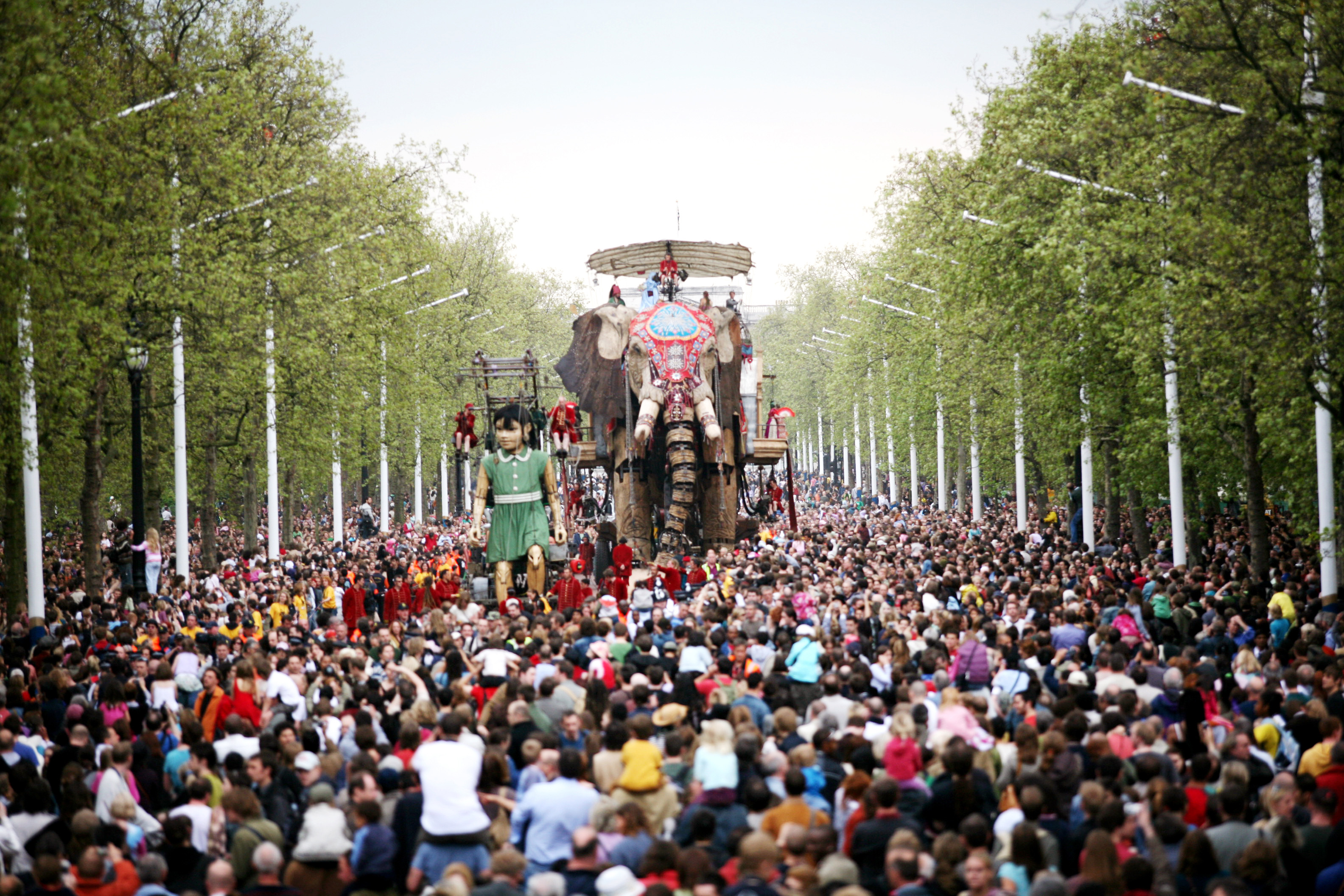
A rocket arrived overnight, as if it had crash-landed in the middle of a London street. And just like that, the city became the stage for an extraordinary adventure – one that would unfold between a giant girl and a giant Elephant.
Royal de Luxe’s The Sultan’s Elephant was a landmark piece of outdoor theatre. In Trafalgar Square, St James’s Park, Horse Guards Parade and Piccadilly, audiences followed the journey of a giant girl and her travelling companions over four days. Along the way they discovered cars that had been ‘sewn’ into tarmac with a giant needle, waved the girl past as she enjoyed a tour atop a red London bus, and were sprayed with water from the Elephant’s trunk.
And then she was gone – vanishing in a puff of smoke as her rocket departed, leaving behind a transformed landscape for outdoor art and propelling Artichoke firmly into the public eye.
Find out more about The Sultan’s Elephant here.
“I have the strangest feeling today, something in between grief and joy, sad that I will never see that beautiful Little Giant or that gargantuan Elephant and happy that I had the privilege to meet them. Thank you for reminding me how to be a child and for realising that cynicism is not a way of life!”
While rehearsing for a month outside the then derelict Battersea Power Station, the team were discovered – giant puppets and all – by a photographer aiming to scoop the show with a double page spread in the Guardian.
Artichoke’s Directors, Helen Marriage and Nicky Webb, stepped in to try to protect the secret, but journalistic hunger triumphed and pictures of the Elephant in rehearsal hit the streets, a day before anyone was supposed to know anything about it.
“What The Sultan’s Elephant represents is nothing less than an artistic occupation of the city and a reclamation of the streets for the people.”
Back in the 2000s, public space was often functional, and cultural experiences were contained – whether it be in galleries, theatres or concert halls. Artichoke’s aim was to produce unique, large-scale experiences that appeal to the widest possible audience, and today, those shared cultural moments feel more important than ever. In a world shaped by algorithms and individualised feeds, truly shared experiences are increasingly rare.
Projects like The Sultan’s Elephant create something collective: a sense of wonder experienced side by side, by thousands of people who might have otherwise never crossed paths. For a brief moment, the city becomes a shared stage, and the memories live on forever.
“When I first wrote to Royal de Luxe back in 1999 (and in those days it was a letter) to ask if they might consider bringing one of their large-scale shows to London, I didn’t anticipate how that simple act would shape my life and the lives of thousands of people in the UK and beyond. They said ‘no, thanks’. They said ‘you English can’t do the things we need to your cities to make such a thing possible.’ They said, ‘we’d rather work anywhere else.’ and when I simultaneously proposed to the authorities in London that they might want to close the ‘ceremonial route’ for four days for a French street theatre group, their response was the same: ‘no, thanks’. ‘Why would we do that?’ ‘What’s it in aid of?’
Seven long years of negotiation later, The Sultan’s Elephant hit the streets with its life-affirming, joyous mixture of theatrical daring and logistical complication. The BBC reported 1,000,000 on the streets – and this, just 10 months after the horrible 7/7 bombings that devastated central London and made the public nervous about hanging out in public space.
The event became a theatrical legend and set the scene for a changed public art landscape where artists were allowed to dream of city streets that could be dedicated to something other than traffic and shopping. Others followed in the Royal de Luxe footprints, most memorably with the public art programme associated with the London 2012 Olympics and other events in cities and towns across our four nations. And Artichoke itself under the co-directorship of me and Nicky Webb, with whom I founded the company, set off on a journey of discovery to see what adventures we could conjure up next…”
~ Helen Marriage, Artichoke Director ~
“Thought I was dreaming when I stepped out of the Royal Academy to see the elephant striding down Piccadilly. Hadn't realised this event was happening but it was truly a magical, unforgettable, take your breath away experience!”
The Sultan’s Elephant was just the beginning.
Over the last 20 years, Artichoke has continued to reimagine public space in ambitious and unexpected ways: transforming the historic city of Durham for Lumiere, the UK’s light art biennial; marking the boundaries of Kirklees with a herd of musical sheep sculptures; and taking over billboards across the UK and Brazil with work by emerging and established artists that responds to the pressing issues of our time. From Antony Gormley’s One & Other, which handed over London’s Fourth Plinth to public participation, to David Best’s vast ornate structures that people filled with mementos before being set alight in moments of collective reflection and healing, we have created extraordinary experiences in unexpected places that bring people together and stay in the memory for ever.
"No amount of statistical analysis will capture the value of the Elephant's visit or why it will be remembered. [...] So what were all these people responding to? I think they were recognising that art, like cuckoos and spring, makes you feel better just be being itself"
This work extends far beyond the events themselves, with more than 100,000 people having taken part in our learning and participation programmes. Working with schools, communities and local partners, these projects create opportunities for people to develop new skills, build confidence and play an active role in shaping the work itself.
Over the coming months, we’ll be revisiting these projects. Follow the series as we delve into the projects, people and ideas that have defined the last 20 years and continue to shape what comes next.
NB: The voice/audio in this blog post has been generated using Artificial Intelligence