

Listen to the blog post here
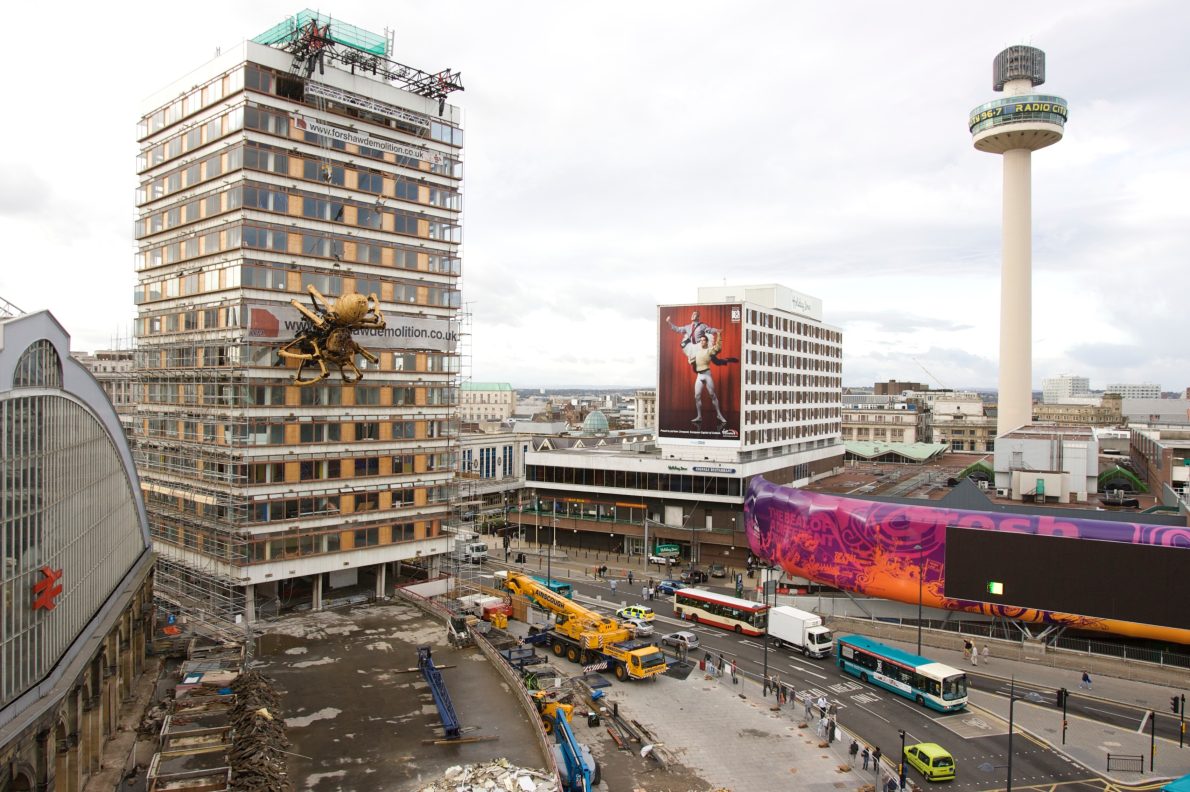
A September morning in 2008 in Liverpool’s city centre saw commuters shuffle to and from train stations, school kids hop off buses, and a giant 37-tonne spider cling onto the side of the soon-to-be-demolished Concourse House.
This was no sci-fi monster, but La Princesse, a 50-foot mechanical spider and the star of La Machine, created by the French street theatre company of the same name, La Machine, and produced by Artichoke. Secretly shipped from France, she was destined to become the centrepiece for Liverpool’s 2008 European Capital of Culture celebrations.
Over the next four days, the giant spider stalked her way through the city, from Lime Street to Castle Street and the Albert Dock, drenching onlookers, dozing beside St George’s Hall, and drawing an estimated 400,000 people out onto the streets.
La Machine became the single moment people point to when they talk about Liverpool’s Capital of Culture year; independent research carried out after 2008 found that the city’s cultural sector rated it the most ‘world class’ event of the entire programme, ahead of the Klimt exhibition at Tate Liverpool…
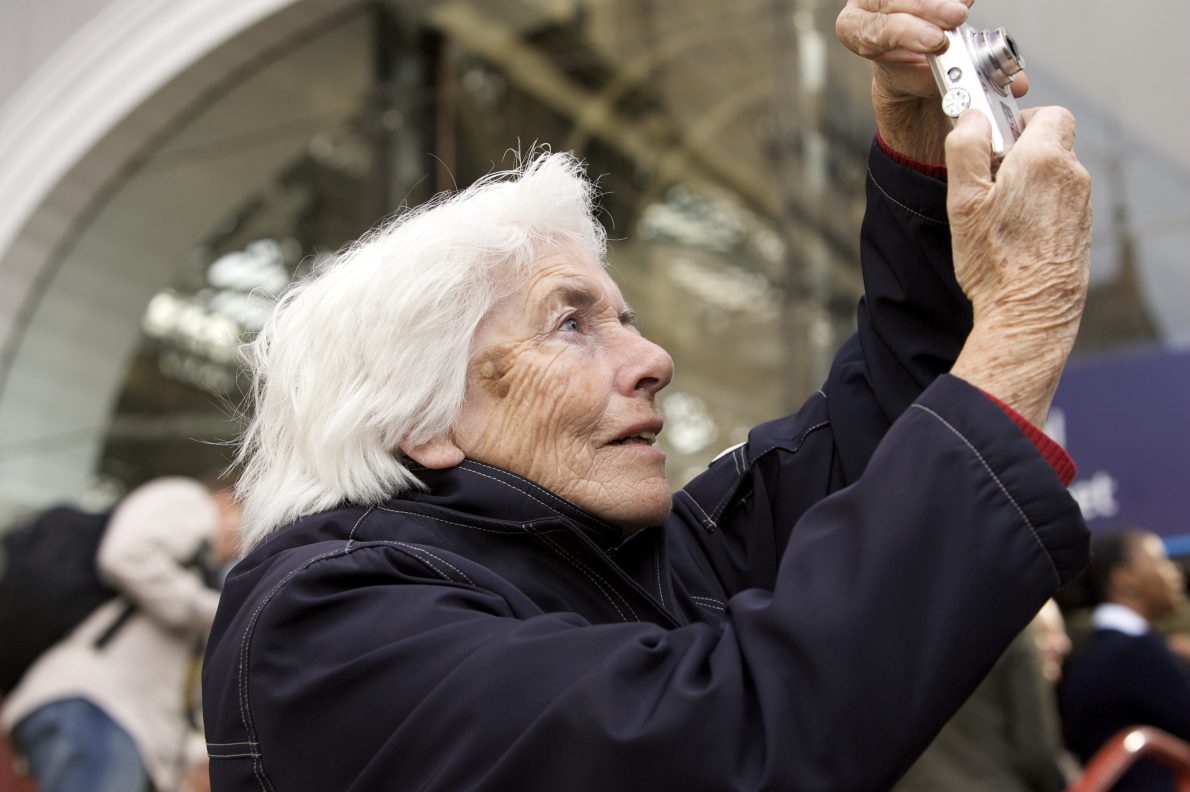
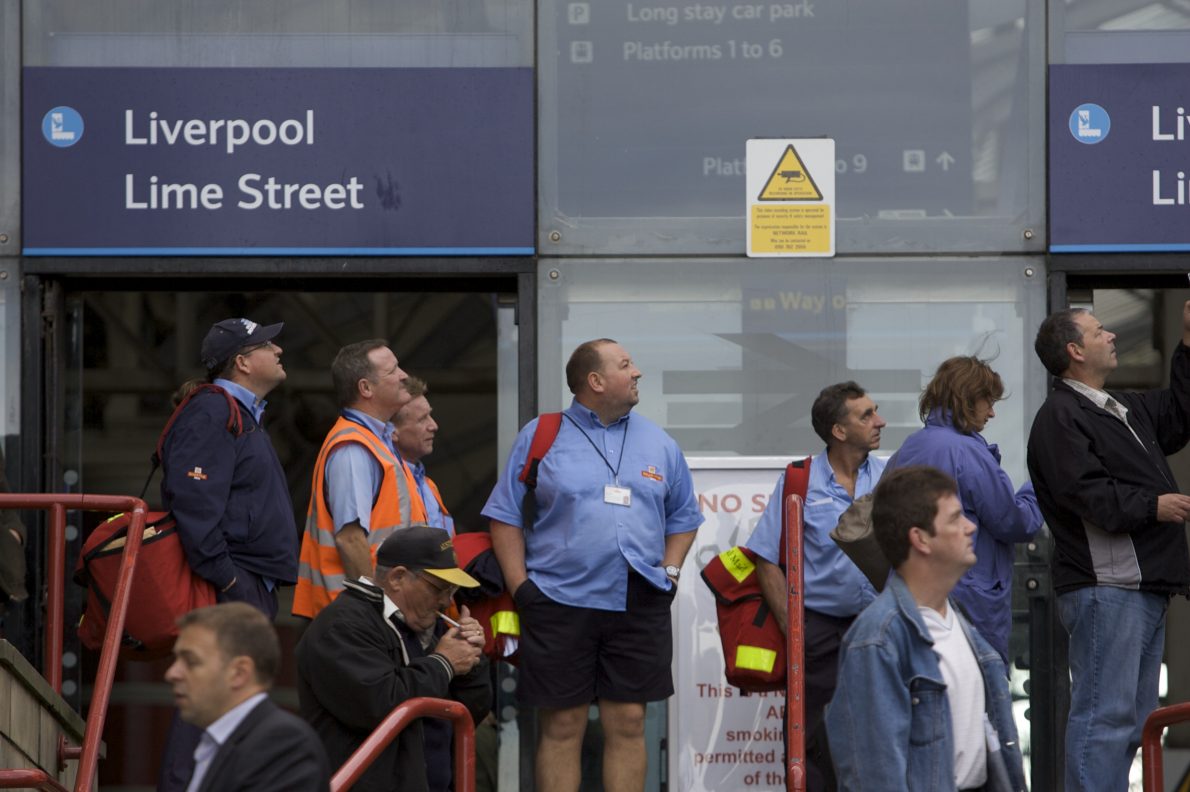
For the thousands gathering outside Lime Street Station on that drizzly morning, it looked like magic, but behind the scenes was a dizzying ballet of city logistics, engineering and street theatre.
Nearly two decades on, La Machine is still the story that gets told first, and the one that created the template for the giant street spectacles Liverpool staged in the years that followed.
La Machine, La Machine, 2008. Produced by Artichoke in Liverpool for the European Capital of Culture celebrations. Photo by Matthew Andrews
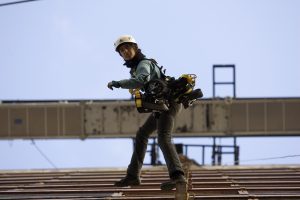
Rigging a creature of this scale directly onto a building in the middle of a live city was an atypical brief, even by La Machine’s standards, so Artichoke recruited the experts from Unusual Rigging to help with the task at hand.
We recently caught up with General Manager, Jim Dugan to better understand how the team brought it all together.
Jim Dugan: In 2008, I was a Production Assistant for Unusual, which consisted of supporting AJ and David Mayo with any project tasks, including site visits, meeting minutes, surveys, drawing site plans as well as liaising with suppliers, local authorities, and our client, Artichoke. The role was extremely varied and really dropped me into the deep end of how large-scale public events were managed from a Technical Production perspective.
Since 2008, I have progressed through the roles of Production Manager, Project Manager and Business Operations Manager, and I am now General Manager at Unusual.
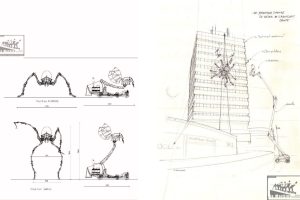
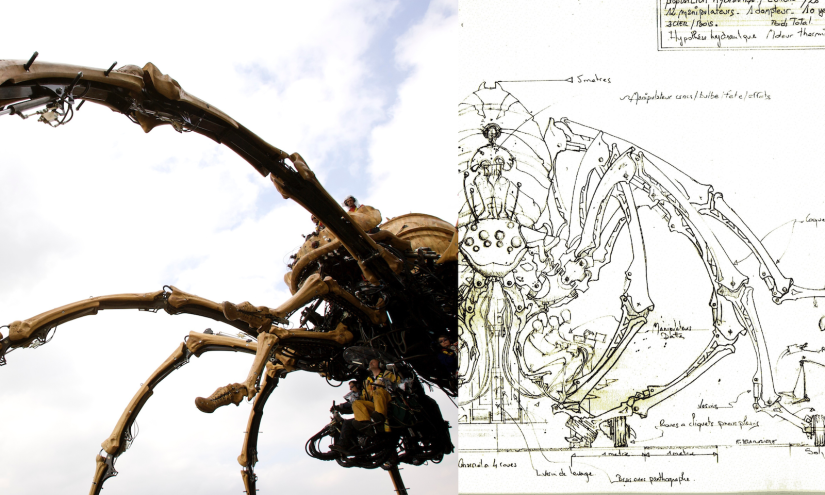
Engineering plans and a concept sketch for La Machine’s giant spider.
JD: The system’s design was dictated by how the load could safely be applied to the building. We could not simply suspend the 37-tonne Spider from the façade, as doing so could have caused significant structural damage. Instead, a ballast (dense material used as weight to provide stability to a structure) was positioned at ground level on the opposite side of the building to act as a counterweight. Bracing connected the ballast to two large spreader trusses positioned on the roof. These trusses cantilevered over the front edge of the building to support the spider.
Several five-tonne chain hoists suspended the Spider from the cantilevers, allowing it to move vertically and laterally across the façade while the operators on board simulated its walking motion. By balancing the Spider’s weight with ballast at the rear of the building, the system transferred only a vertical load through the structure.
JD: For this question, I would defer to my colleague Simon Tiernan, our Managing Director. Simon was a senior rigger in 2008 and played a crucial role in the design and installation of the Concourse House system.
Simon recalled that, despite the necessary road closures being in place, the local taxi rank prevented the team from working at the rear of the building. The lifting plan therefore had to be revised on site, and all lifting operations were carried out from the front of the building.
Night work brought the usual operational challenges, including reduced visibility, changing weather conditions, restricted welfare facilities and increased site-security requirements. Fatigue was another significant consideration, as the team had to adjust its normal sleeping patterns to work safely through the night. On this project, those pressures were compounded by the need to complete the installation before commuters arrived the following morning.
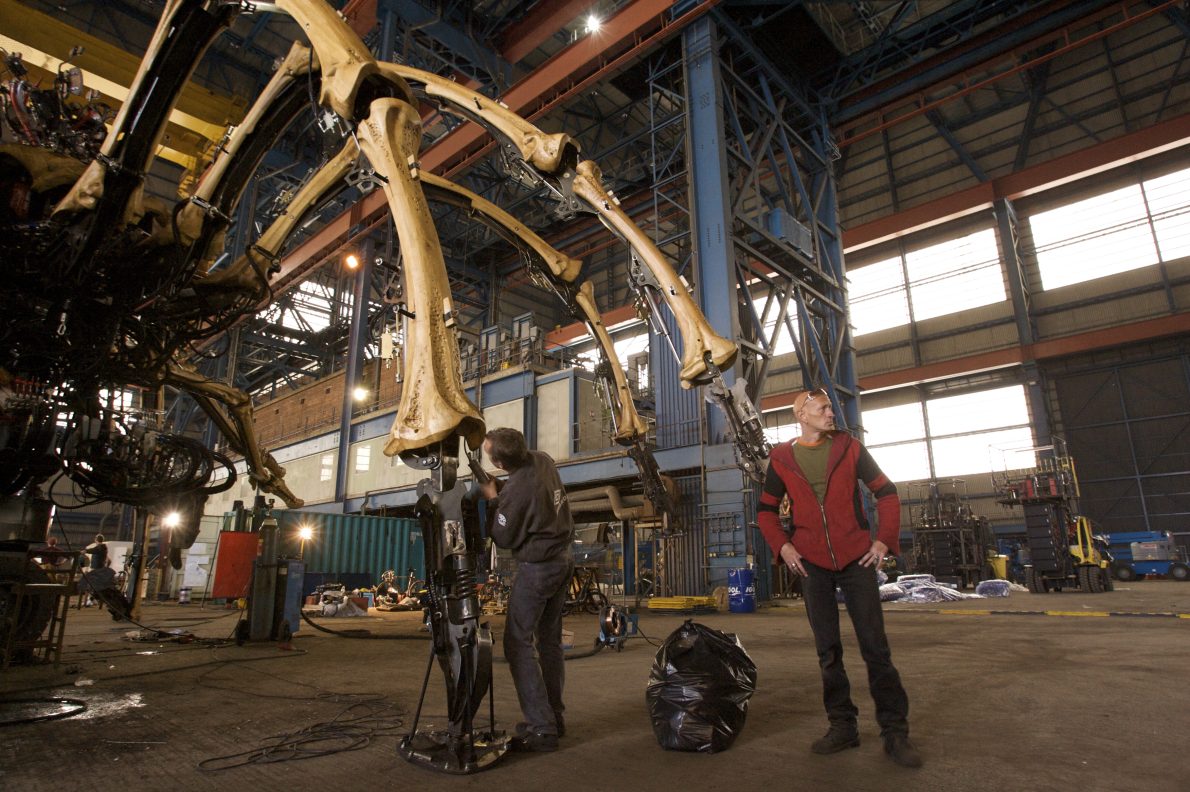
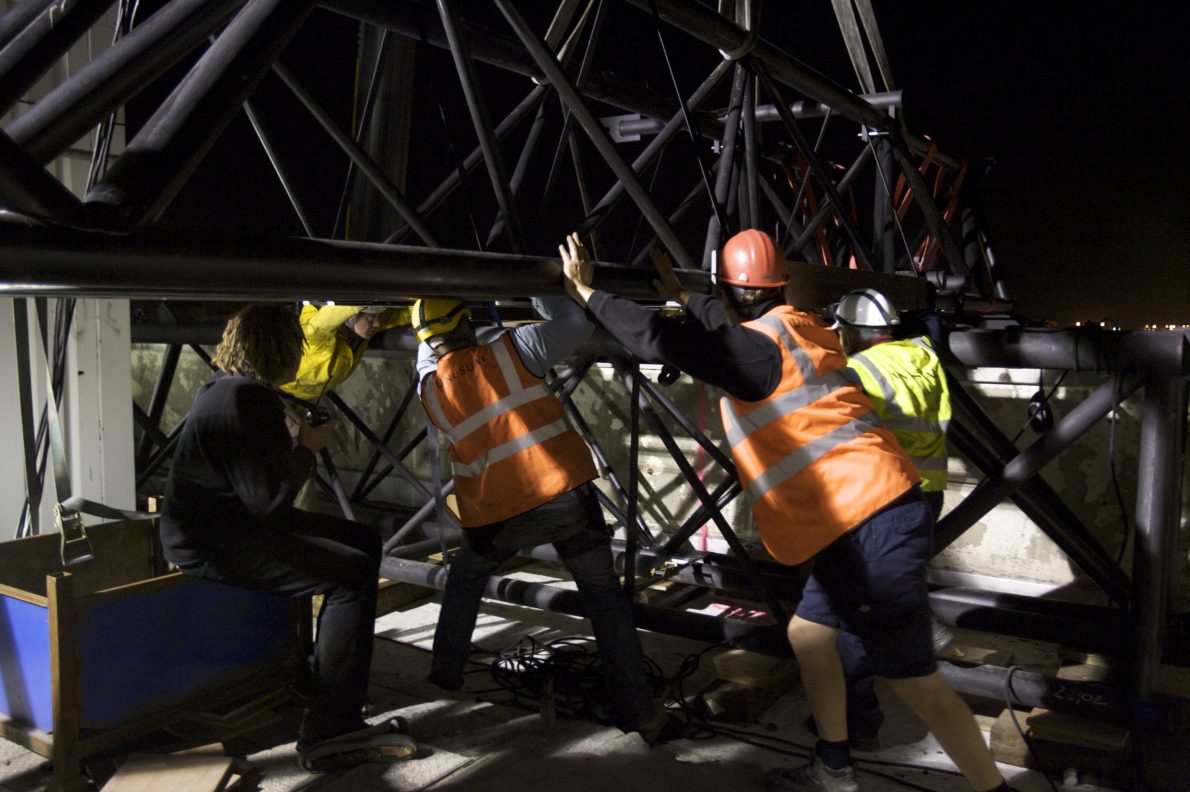
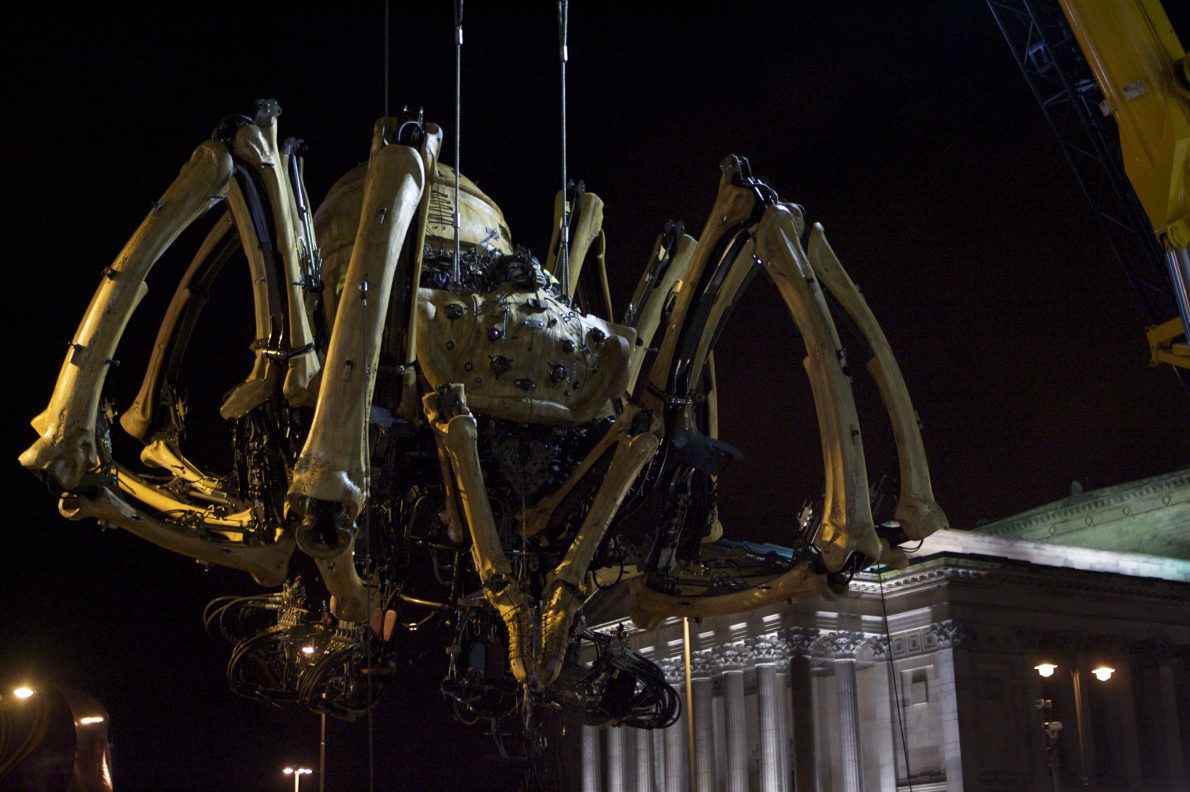
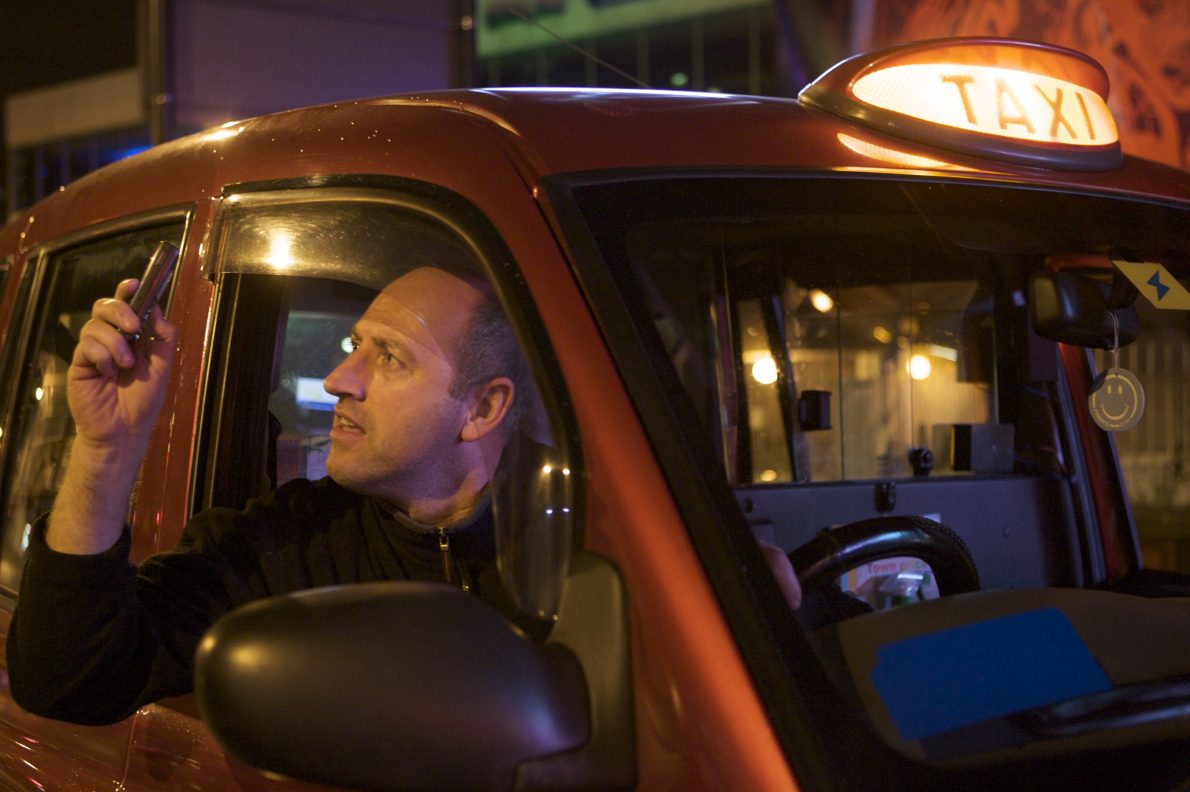
Though 1000 times bigger than the average household spider, La Princesse could bend and flex at around 40 different joints, driven by hydraulics and worked by operators riding on the machine itself. 14 performers operated La Princesse from within and around her frame. Once she was secured to the building, the team abseiled down the facade and into pre-rehearsed positions, ready to begin the choreography that gave the spider her uncanny gait.
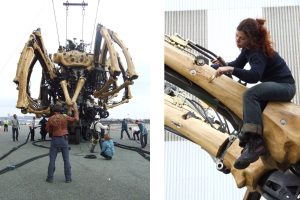
Rehearsals at Cammel Laird Shipyard, La Machine, 2008. Produced by Artichoke in Liverpool for the European Capital of Culture celebrations. Photo by Matthew Andrews
Long before any logistics could be worked out, the idea had to be sold to the city itself. Following Artichoke’s inaugural project, The Sultan’s Elephant, in London in 2006, we initially explored the possibility of bringing another Royal de Luxe creation to Liverpool – a deep-sea diver was among the ideas being considered, but the project was eventually parked. Royal de Luxe would later return to the concept, staging Sea Odyssey in Liverpool in 2012.
Instead, in the summer of 2007, Artichoke travelled to Nantes to meet François Delarozière of La Machine and pitch a new commission for Liverpool. Delarozière proposed something rather different: a giant spider.
Concourse House itself was chosen because it presented an exciting engineering challenge, and partly through happy accident: due to be demolished, the building was scheduled for redevelopment within the same year as the City of Culture festivities, which meant a two-week window for the production could be negotiated directly into the site’s contract. Once Delarozière saw the building, the idea of the spider waking there quickly took hold.
Liverpool’s geography shaped the rest of the route. Unlike Manchester or London, it has no obvious central civic square: plenty of parks, but no single expansive space at the heart of the city. For the finale, the choice was therefore an obvious one: the broad open ground in front of St George’s Hall.
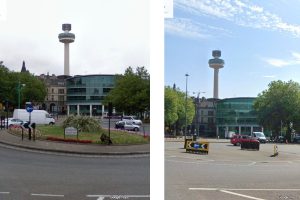
Roundabout outside Queensway Tunnel 2008 & 2023, Liverpool. Image capture courtesy of Google
To make room for the spectacle, a roundabout outside the entrance to the Queensway Tunnel was dug up in the run-up to 2008. The city was compensated for its removal as part of wider works, and the roundabout was never reinstated. What had once been a traffic junction became an open civic space – one that the city continues to use for large-scale public gatherings today.
None of this would have worked without the city’s institutions agreeing to treat its streets, stations and emergency infrastructure as part of the stage set. Liverpool City Council, the emergency services and Network Rail spent months working through the risks of accommodating a 37-tonne machine beside a major rail hub. Engineers scrutinised the wall brackets and wind-loading calculations for Concourse House, while the route from Castle Street to Albert Dock was checked for cellars, utility lines and Victorian brickwork that could be vulnerable to the spider’s weight.
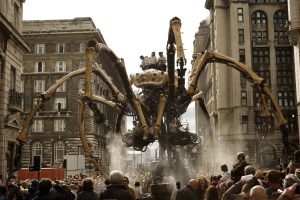
La Machine, La Machine, 2008. Produced by Artichoke in Liverpool for the European Capital of Culture celebrations. Photo by Matthew Andrews
To keep the illusion intact, and allowing the spider to ‘roam’ the city on what appeared to be her own terms was as much a logistical feat as the rigging itself. The procession alone required 16 cranes, six forklifts and eight cherry pickers, alongside the water-cannon effects that drenched crowds during the sequences at Salthouse Dock.
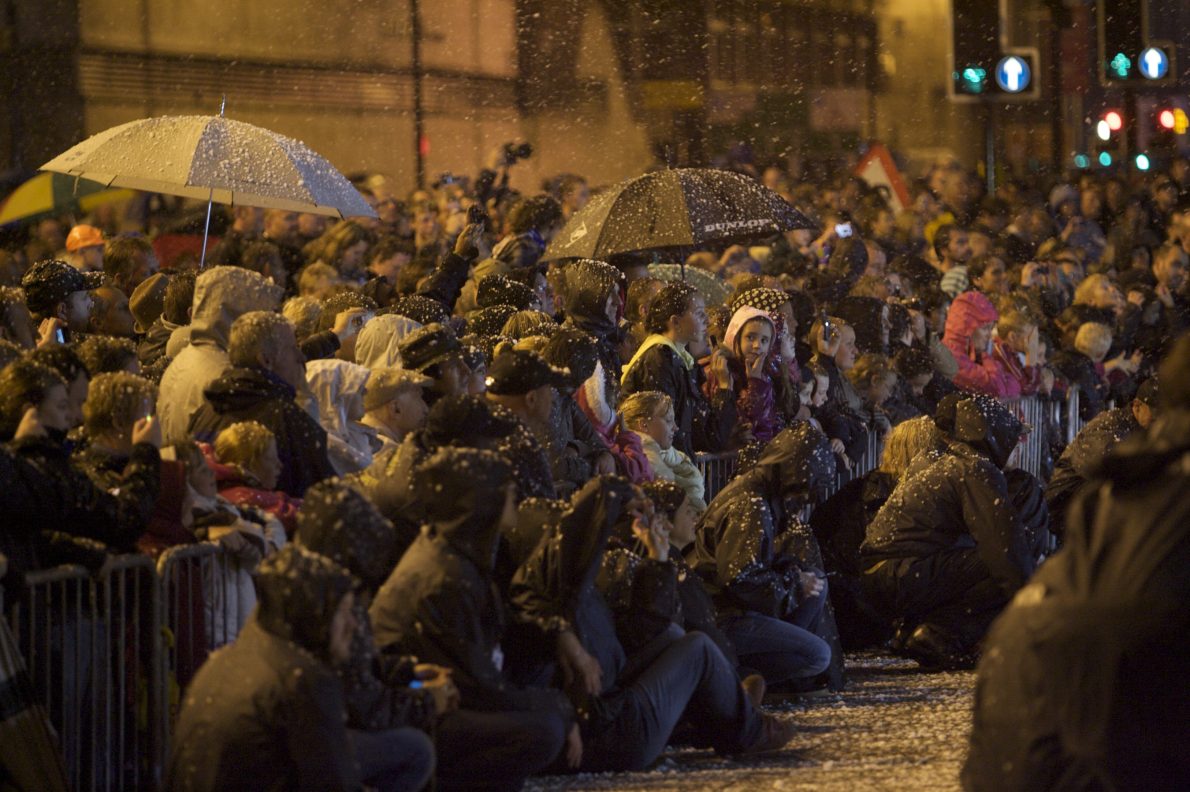
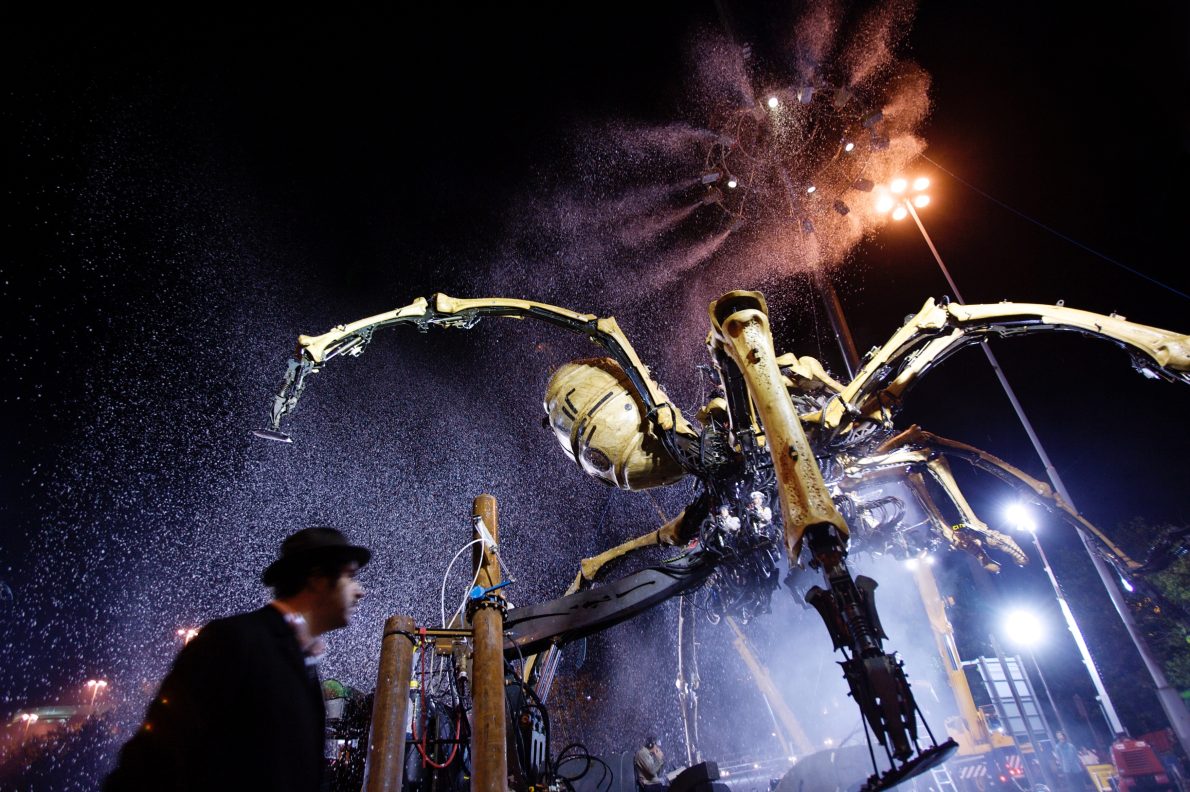
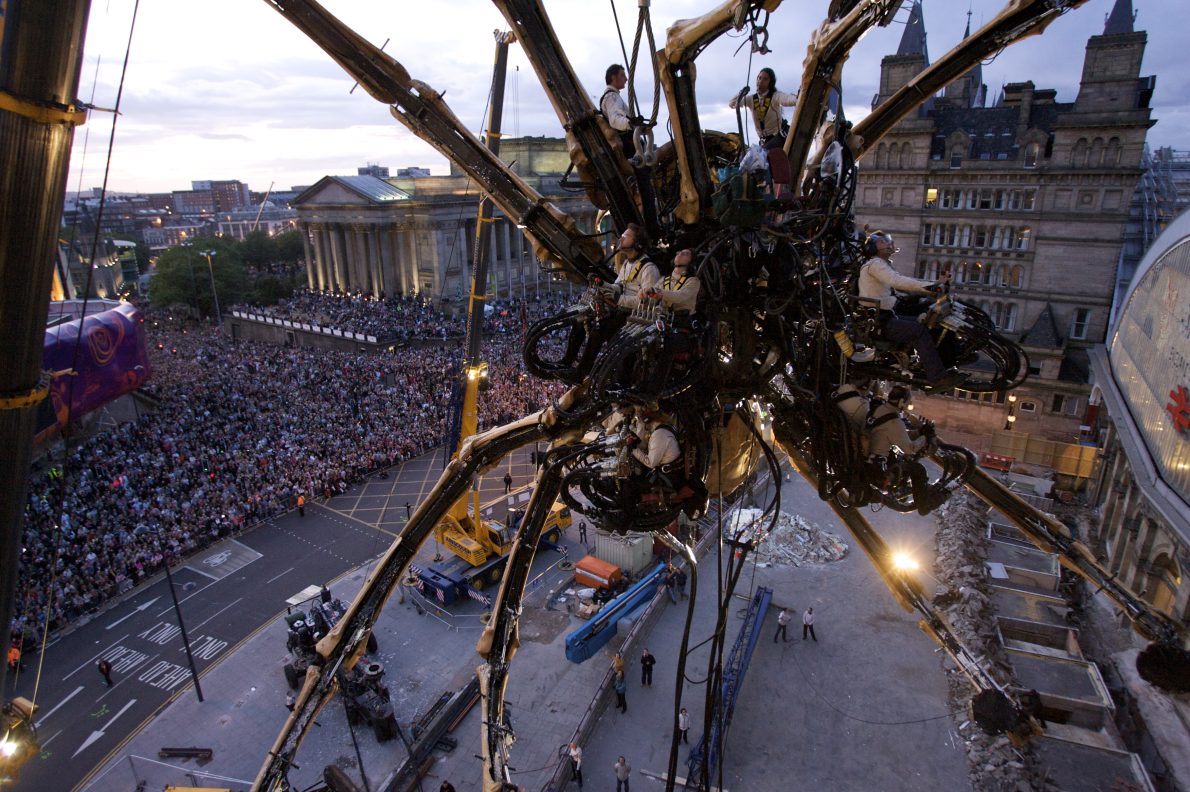
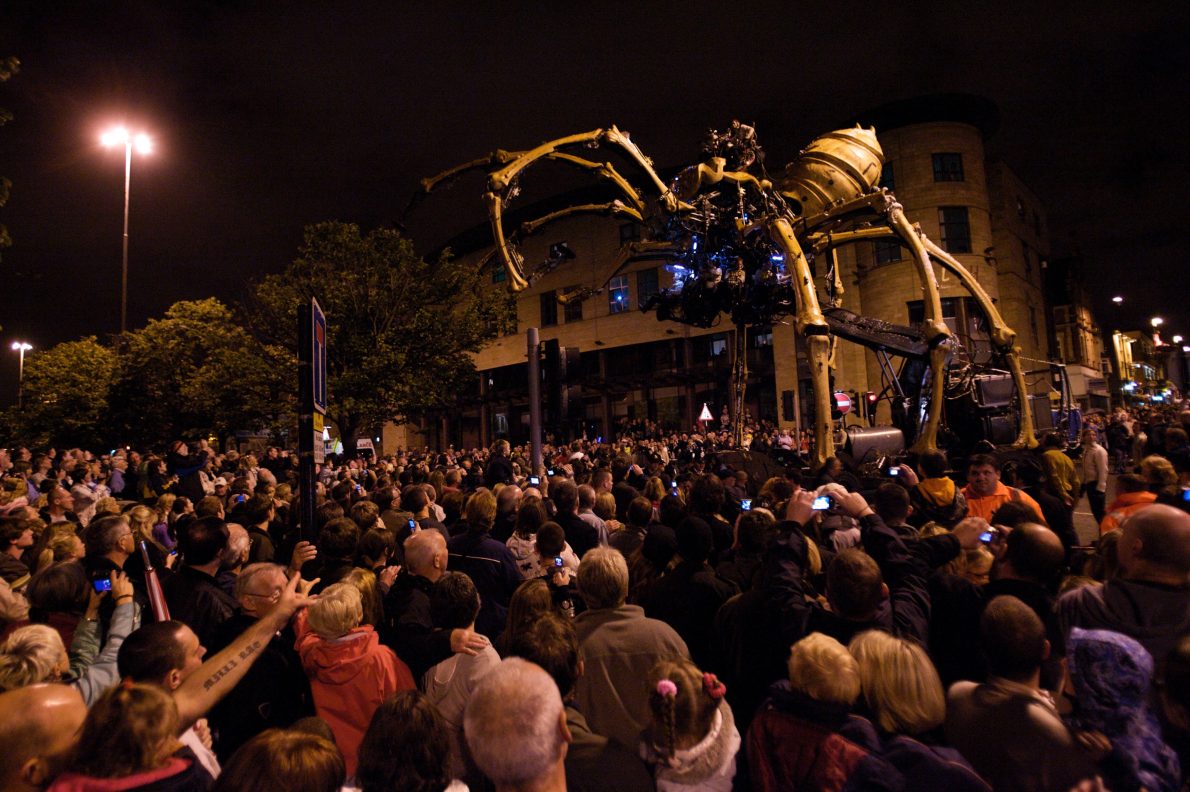
La Princessa’s route took her through Liverpool’s Castle Street and towards the water and, eventually, to the mouth of the Queensway Tunnel beneath the Mersey. After navigating the tightest of clearances to reach the tunnel entrance, the machine appeared to vanish underground and out of the city, bringing the four-day performance to a close before crowds who had followed her journey from the start.
JD: At the tunnel entrance, La Machine and its technicians created the main effects using water, fire, snow and smoke, accompanied by a cacophony of sound. Together, these elements produced an exceptional finale to a remarkable piece of public theatre. Unusual’s role focused on the operational framework that made the finale possible, including vehicle logistics, road closures, crowd management and security.
It remains an experience I will never forget and one that is difficult to describe in a way that fully does it justice.
La Machine, La Machine, 2008. Produced by Artichoke in Liverpool for the European Capital of Culture celebrations. Photo by Matthew Andrews
In a year jam-packed with events, La Machine was the third most-covered in the national press, behind the opening weekend for the European Capital of Culture and Paul McCartney’s concert.
Independent analysis commissioned after the Culture Capital festivities put the visit’s direct economic impact to the city at more than £2 million, but the more lasting effect was on how Liverpool thought about staging events in its own streets. The production is widely credited with giving Liverpool the confidence and experience to embrace street theatre on this scale, helping to lay the groundwork for the relationship the city would go on to build with Royal de Luxe.
Nearly two decades after the spider first prised open a pair of office windows on Concourse House, Liverpool’s willingness to surrender its streets to oversized, faintly impossible spectacles remain one of the more unusual legacies of its Capital of Culture year.
[La Machine] remains an experience I will never forget and one that is difficult to describe in a way that fully does it justice.
NB: The voice/audio in this blog post has been generated using Artificial Intelligence